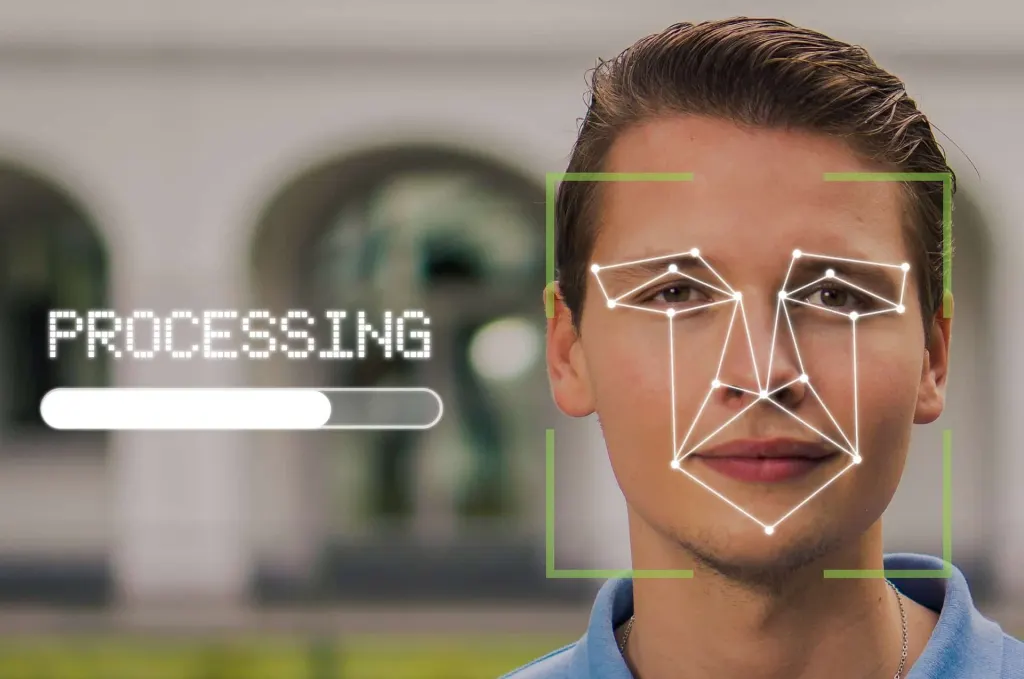
Face recognition attendance works by capturing an employee’s face at clock-in, converting it into a mathematical template, and matching it against a stored template to confirm identity in seconds. It is contactless, fast, and hard to fake.
The steps behind a face clock-in
- Enrolment: the employee scans their face once; the system stores an encrypted template for matching.
- Capture: at clock-in, the camera captures the face on a phone, tablet, station or IP camera.
- Matching: the live capture is compared to the stored template.
- Record: a verified, time-stamped (and often geo-located) entry is logged.
Does it work with masks or in poor light?
Quality engines handle many real-world conditions, but where a face cannot be used — heavy PPE, face coverings, very low light — a good system falls back to another method, such as fingerprint, iris, an RFID card, a QR code or a PIN, so attendance still works for everyone. Staff who decline biometrics can use an RFID card, a QR code, a PIN or manual entry.
Is face recognition attendance accurate?
Accuracy depends on the underlying algorithm. NCheck is built on Neurotechnology’s biometric engines, and combining face with fingerprint (multi-modal) raises accuracy further and resists spoofing.
FAQ
Is my face photo stored? Matching uses an encrypted mathematical template. Event photos are kept as proof of each check-in and can be deleted automatically after a period you set. On-premises deployment keeps all of it on your servers.
See NCheck on your own devices. NCheck is a biometric time & attendance, access control and visitor management platform that runs on phones, tablets, IP cameras or terminals — in the cloud or fully on-premises. Book a demo.